Government Workflow Automation Platform · Dec 2025 - Apr 2026 · 5 months
Designing AI-powered form-to-workflow automation for government teams
As lead product designer, I collapsed a manual upload-check-build process into bulk upload and an AI prompt, then designed the API builder and workflow canvas that turned government paperwork into automated, AI-generated workflows.
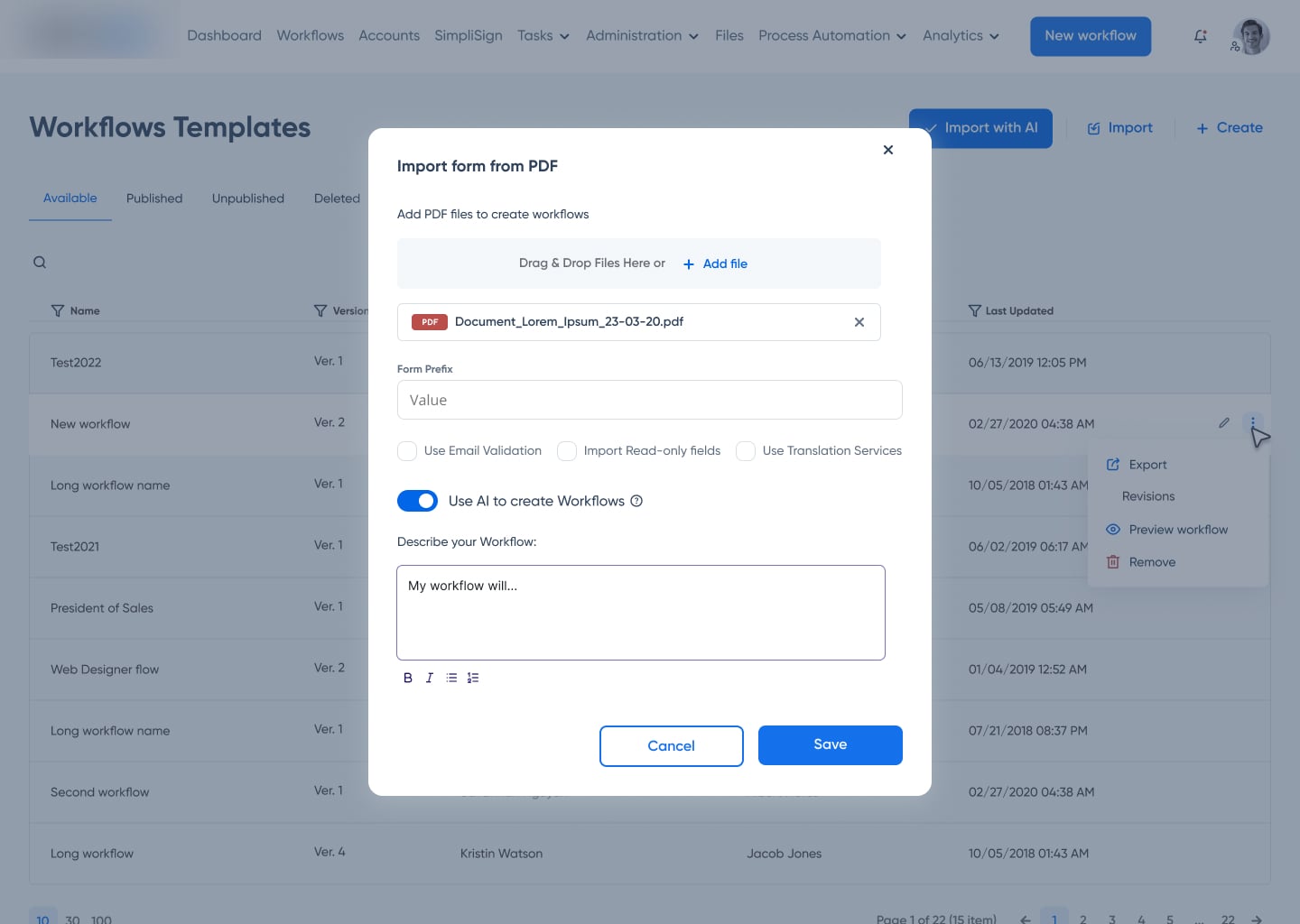
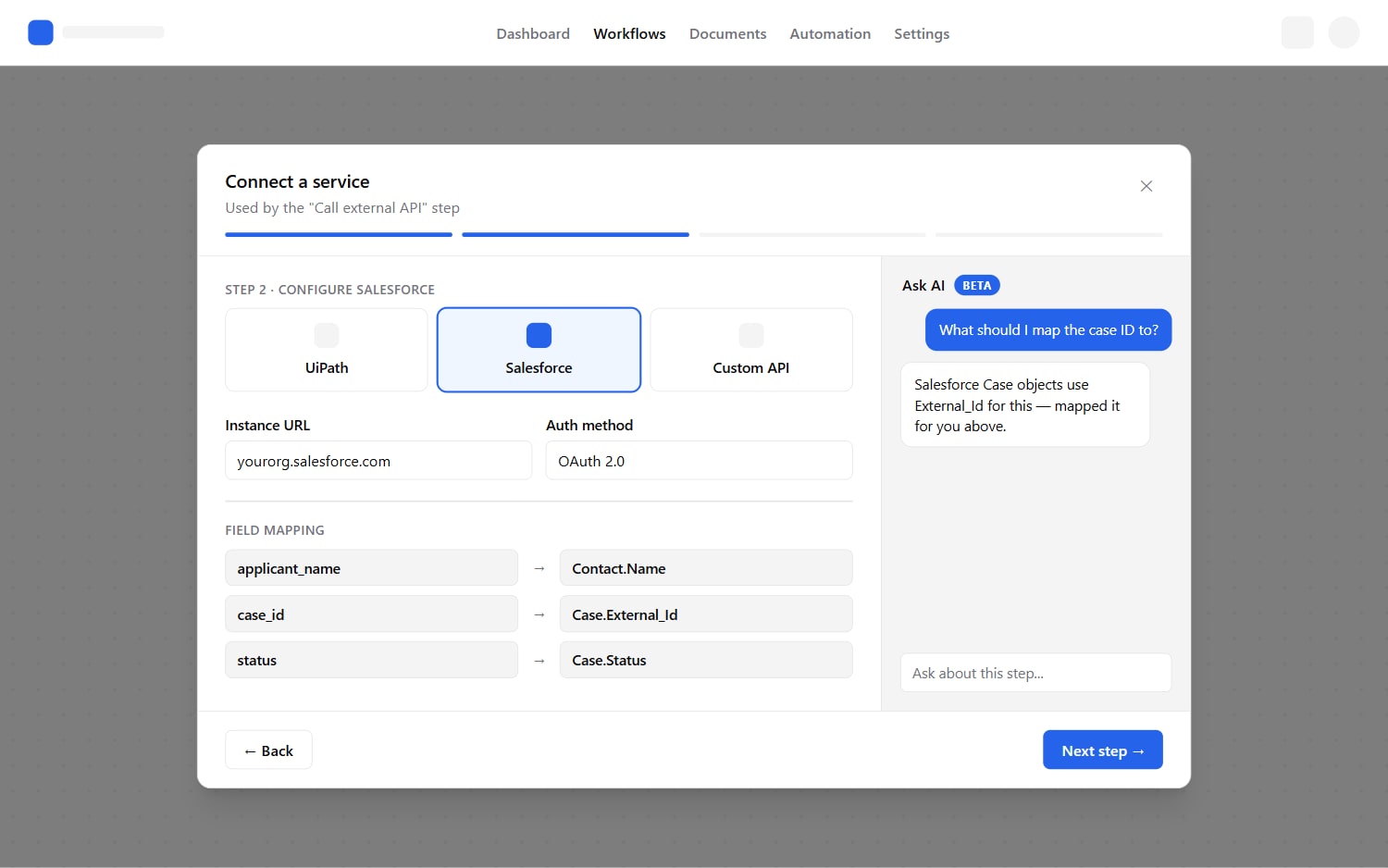
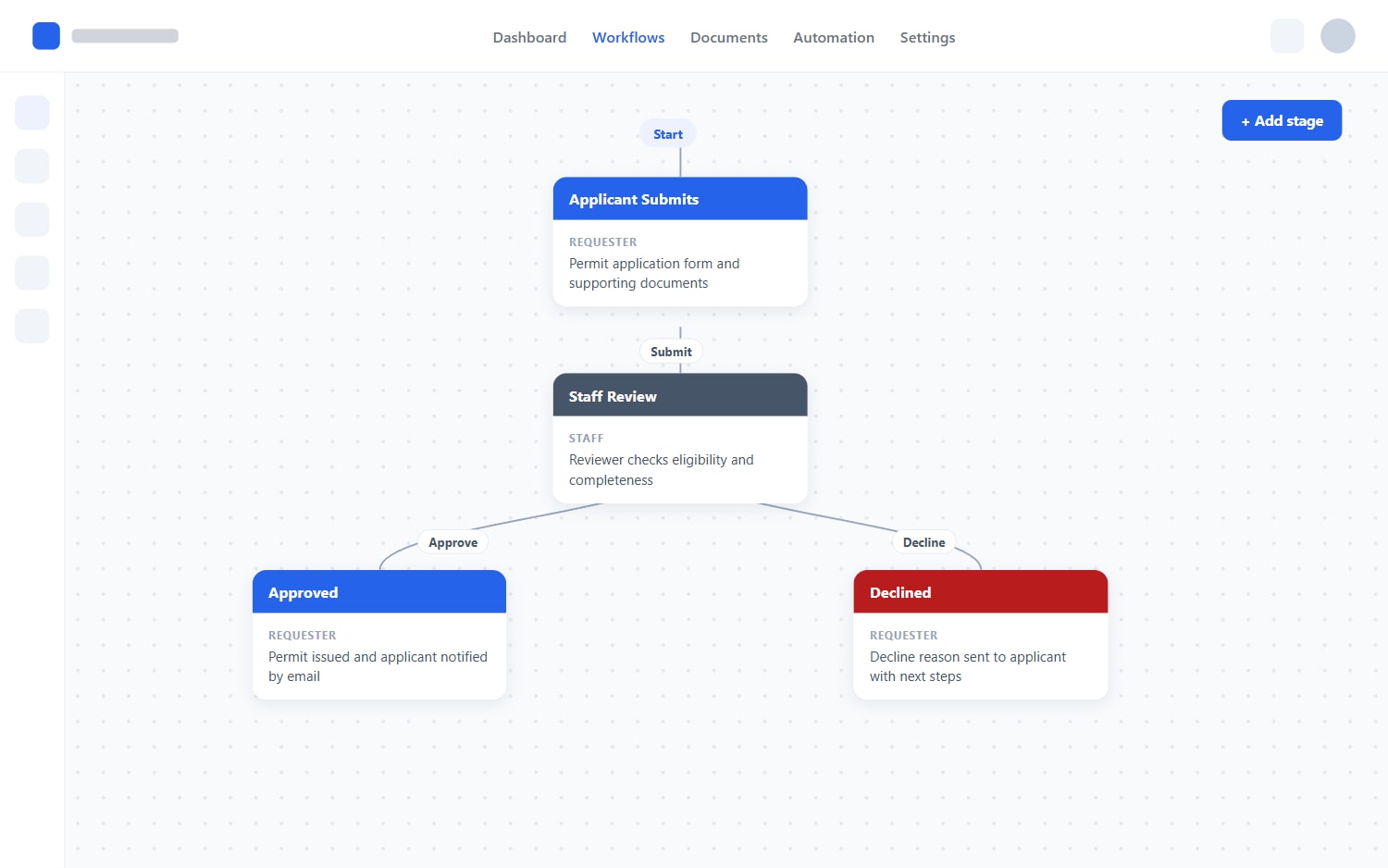
This project is under NDA - the company name and product branding have been withheld. One screen below is a real product screen with the logo blurred; the other two are illustrative mockups I rebuilt to show the design patterns accurately, not real product screens.
Team
Product managers, engineers, and an AI/ML team
Scope
Bulk upload & AI-generated workflows, API builder, workflow canvas
Constraint
End users were non-technical government staff, not developers
Duration
5 months, Dec 2025 - Apr 2026
The problem
Before I joined, the platform already had an AI/OCR engine that could read an uploaded document and recreate it digitally - but the interface around it was old, and turning that into a working workflow was entirely manual: upload a file, manually check every extracted field, then manually build the workflow phase by phase, as three separate steps. The client wanted fewer steps, with AI doing more of the work. The bigger challenge sat in two places I ended up owning end to end: an API builder that had to fit a lot of dependent, service-specific configuration without overwhelming a non-technical user, and a workflow canvas that had to stay legible even once AI started generating most of a flow automatically instead of a person building it node by node.
Process
Replaced a three-step manual process with bulk upload and an AI prompt
Before this redesign, creating a workflow meant uploading a file, manually checking every extracted field, then manually building the workflow phases - three separate manual stages. I added a bulk upload option and a short wizard where you map fields and describe what you want in a plain-language prompt, then let AI generate a first-pass workflow with suggestions instead of leaving every step to be built by hand.
Designed the API builder around dependent steps instead of one static form
The API builder had to hold a lot: which service to connect, service-specific configuration that changes based on that choice, an AI chat for in-context help, and the ability to move back and forth between steps without losing progress. I structured it so later steps are generated based on earlier choices, instead of trying to show every possible option at once.
Rebuilt the workflow canvas to stay legible as flows got AI-generated
Once workflows could be generated automatically by AI instead of built node by node, the canvas needed to stay easy to scan even as it filled up fast. I kept it as a flat, flowchart-style graph - clear branches, labeled paths like Approve and Decline - and tightened the visual language so it read as a clean, modern automation tool instead of a dense diagram.
Selected screens
Key decisions
Tested the drawer against the real configuration complexity
The initial direction for the API builder was a persistent side drawer. Before committing to it, I prototyped the experience using the actual service-specific configuration, dependencies and navigation users would need.
Once real content was introduced, the drawer became too constrained. A step-based modal gave each decision enough space, made dependencies between steps clearer, and still allowed users to move backward without losing progress.
Comparing the two approaches against the real content made the trade-off clear, and we aligned on the multi-step model.
Used AI-assisted prototypes to make implementation discussions more concrete
AI-assisted prototypes were still new to parts of the engineering team, so I didn't treat them as a replacement for established handoff practices.
I used them to demonstrate interactions, states and edge cases earlier, then supported them with the specifications and communication engineers needed for implementation.
That let me keep the speed of coded exploration without making the development process depend on a new tool or workflow the team hadn't adopted yet.
Outcome
3 steps to 1 prompt
collapsed a manual upload-check-build process into bulk upload plus a single AI-generated first pass
Complex configuration, broken into clear dependent steps
shipped a multi-step, dependent-step modal instead of the originally preferred drawer, after proving it fit the real complexity better
AI-generated, still legible
workflow canvas redesigned to stay scannable even when AI generated most of a flow automatically
Described qualitatively - exact adoption and efficiency figures weren't tracked in a form precise enough to cite here.
What I’d do differently
“Client preference and the original spec both pointed toward a drawer for the API builder, and I still ended up arguing against it - not because the reasoning behind it was wrong in the abstract, but because it didn't hold up once real content got poured into it. That's the pattern I'd trust more of going forward: treat even well-reasoned direction as a hypothesis until it's been tested against the actual number of options and steps a real user needs, not the ideal case.”